

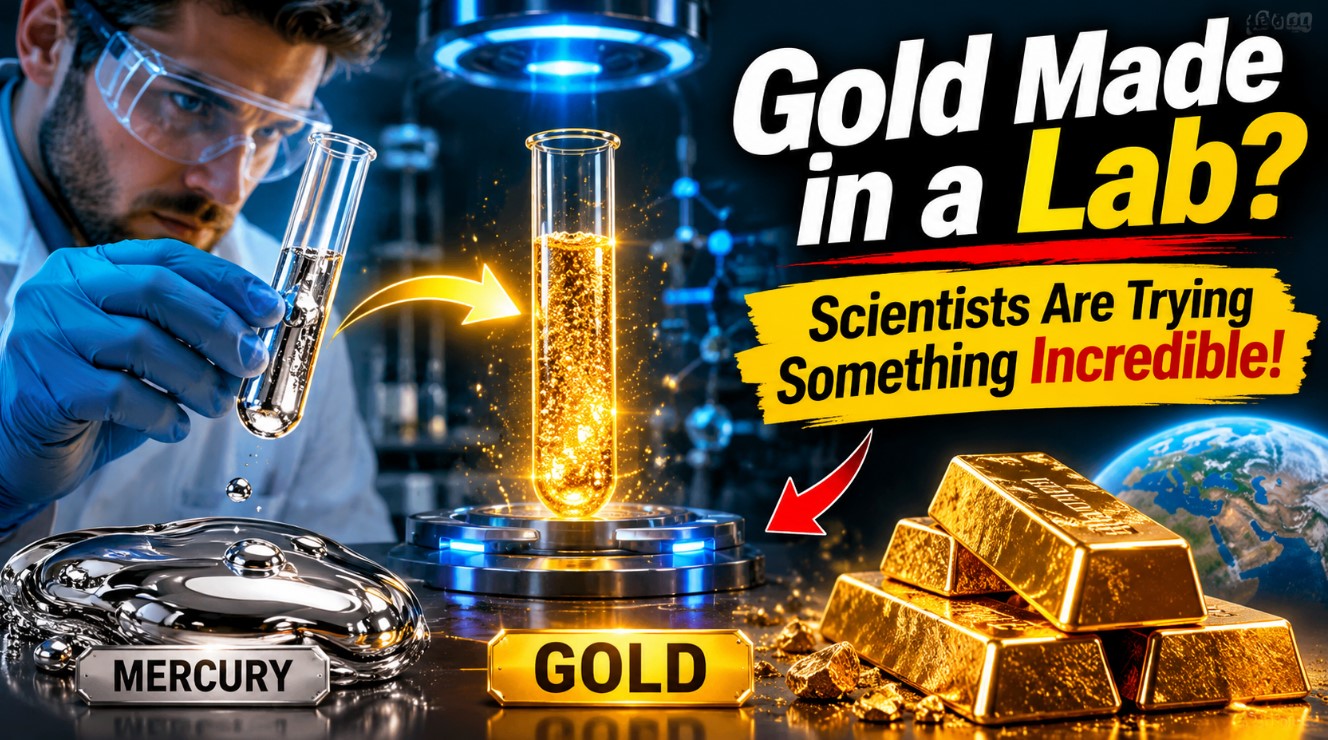

Scientists are exploring artificial gold production. Discover how Marathon Fusion and a Bengaluru inventor are attempting to turn mercury into gold.
For thousands of years, humans have been fascinated by gold.
Kings fought wars for it. Empires built their wealth around it. Explorers crossed oceans searching for it. Even today, gold remains one of the world’s most treasured assets.
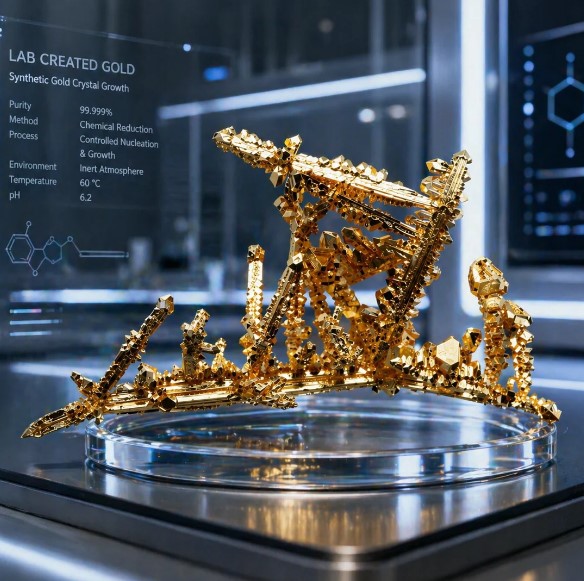
But imagine a future in which gold is not only extracted from the ground but also produced inside a laboratory.
It sounds like something from a science fiction movie. Yet scientists and technology companies are exploring exactly this possibility.
In October 2026, a San Francisco-based startup called Marathon Fusion made headlines after claiming that it had successfully converted mercury into stable gold using nuclear fusion technology.
Around the same period, a Bengaluru-based inventor also attracted attention for a patented experimental process that reportedly detected gold and silver in treated mercury samples.
Are we witnessing the beginning of a new scientific era, or is the world getting excited about experiments that still have a long way to go?
Let’s understand what is happening.
The US Startup That Claims to Have Made Gold From Mercury
Marathon Fusion, a San Francisco-based fusion energy startup, announced on October 21, 2026, that it had demonstrated the conversion of mercury into stable gold.
The company described its achievement as a major step in nuclear transmutation, claiming a production rate ten times higher than a benchmark associated with CERN’s earlier experiments.
The announcement immediately attracted attention because it touched on one of humanity’s oldest scientific ambitions: artificial gold production.
But how could mercury become gold?
The answer lies inside the atom.
Read Also: Gold Recipe
How Can Mercury Be Converted Into Gold?
Gold and mercury are two different chemical elements.

Gold has 79 protons in its atomic nucleus, while mercury has 80.
To transform mercury into gold, scientists must change the composition of its atomic nucleus. This is fundamentally different from an ordinary chemical reaction.
Marathon Fusion says its proposed process uses high-energy neutrons generated through nuclear fusion.
According to the company’s explanation, the process works by exposing mercury-198 to these neutrons. This produces mercury-197, an unstable radioactive isotope that eventually decays into stable gold-197.
In simple language, the technology attempts to change the identity of the atom itself.
This process is known as nuclear transmutation.
It is not magic. It is nuclear science.
CERN Had Already Produced Gold During Its Experiments
Marathon Fusion is not the first organization to explore artificial gold production.
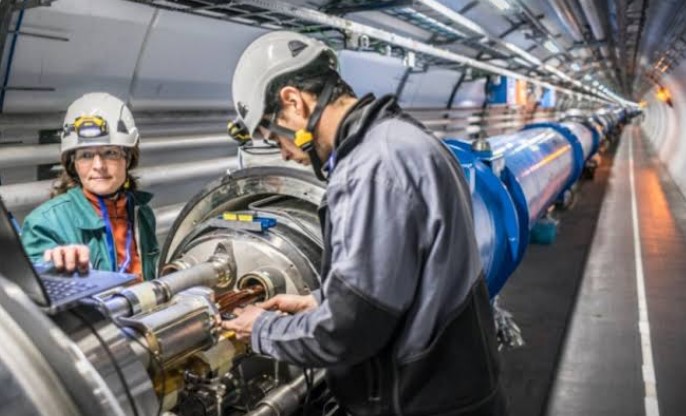
Scientists working at CERN, the European Organisation for Nuclear Research, have also demonstrated that gold nuclei can be produced through high-energy particle experiments.
Research conducted using the Large Hadron Collider between 2015 and 2018 showed that lead nuclei could lose protons during extremely close interactions, resulting in gold nuclei.
In a 2025 report, CERN estimated that approximately 29 picograms of gold nuclei had been produced.
That sounds exciting, but there is an important detail.
These gold nuclei existed for incredibly short periods and were not collected as usable physical gold. They were destroyed in subsequent interactions with the accelerator’s equipment.
This demonstrates that nuclear transformation is scientifically possible, but it does not mean scientists have found a practical way to manufacture gold for jewellery or investment markets.
Another Interesting Development in Bengaluru for Gold
While the US startup attracted attention through fusion technology, another unusual development emerged from Bengaluru, India.
Inventor Rajah Vijay Kumar, associated with the Scalene Energy Research Institute, has developed a patented experimental process called Gravitoradiophysical Nuclear Transmutation, or GNT.
The technology uses a specially designed apparatus called the Boom Tube.
According to reports published in November 2026, the inventor claims that specially generated frequencies can help transform chemical elements.
Laboratory analysis of treated mercury-containing samples reportedly detected gold and silver.
The reported gold concentrations included 1.91 milligrams per litre in one sample and 2.3 milligrams per litre in another.
However, these findings require careful interpretation.
The analytical technique used to identify elements can detect the presence of gold, but detecting gold does not automatically prove that mercury was transformed into gold.
Independent experiments must establish where the gold originated and whether the proposed transformation actually occurred.
The patent is an interesting development, but it should not be confused with independent scientific proof that the technology works as claimed.
Could Artificial Gold Destroy the Value of Natural Gold?
This is perhaps the most interesting question.
Gold is valuable partly because it is difficult to extract, refine and obtain in large quantities.
Its scarcity, industrial applications, cultural importance and role in financial markets all contribute to its value.
If technology eventually allows companies to manufacture gold at an affordable cost, the global gold industry could face an entirely new situation.
Consider the possible consequences:
1. A new source of gold
Artificial production could eventually provide another source of precious metals alongside traditional mining.
2. Changes in the mining industry
If laboratory production becomes commercially competitive, traditional gold mining companies may face new competition.
3. Industrial applications
Manufactured gold could potentially support electronics, specialized manufacturing and other industries that depend on precious metals.
4. Questions about gold investment
If large quantities of artificial gold become economically available, investors may begin questioning how production technology could affect long-term scarcity.
However, these are possibilities, not predictions.
At present, neither announcement establishes that artificial gold can compete economically with mined gold.
External References
- Marathon Fusion: Official Website
- CERN: European Organisation for Nuclear Research
- Business Standard: Marathon Fusion’s Gold Claim
- The Economic Times: Bengaluru Inventor’s Gold Experiment
The Biggest Challenge Is Not Making Gold. It Is Making It Cheaply.
Here is where the excitement meets reality.
Producing a few atoms or tiny quantities of gold through nuclear processes is very different from manufacturing kilograms or tonnes at a commercially attractive cost.
There are several major challenges:
- The technology requires highly specialized scientific equipment.
- Nuclear reactions involve complex engineering and safety requirements.
- The resulting material must be recovered and purified.
- Radioactive isotopes and contamination must be carefully managed.
- Production costs must compete with conventional gold mining and refining.
Marathon Fusion has discussed the possibility of producing substantial quantities of gold through future fusion power plants.
However, those figures are projections based on proposed technology, not demonstrated commercial production.
The company has not publicly established the economics of its claimed experimental achievement.
Will We Buy Laboratory-Made Gold in the Future?
Imagine walking into a jewellery store ten or twenty years from now.
You see two gold products.
One comes from a traditional gold mine. The other has been manufactured through advanced nuclear technology.
Would customers consider them equally valuable?
From a chemical perspective, gold atoms are gold atoms, regardless of their origin, provided the material has the same composition and purity.
But the commercial value could depend on production costs, certification, traceability, consumer confidence and market supply.
The jewellery industry, mining companies and investors could eventually face questions that seemed impossible only a few decades ago.
For now, that future remains uncertain.
The Real Story Is Bigger Than Gold
What makes these developments interesting is not simply the possibility of creating another precious metal.
It is the growing ability of science to manipulate matter at the atomic level.
The same broader field of nuclear science and advanced materials research could contribute to energy production, medical isotope development and specialized industrial applications.
Marathon Fusion, for example, is also exploring technologies related to medical isotopes.
Perhaps artificial gold will eventually become commercially viable. Perhaps the engineering and economic challenges will prove too difficult.
Either way, the experiments raise a fascinating question about the future of science.
For thousands of years, humans searched the Earth for gold.
Now, some are attempting to create it.
And if science eventually succeeds at an affordable scale, the meaning of gold scarcity could change forever.
What do you think? Would you buy laboratory-created gold if it had the same purity as naturally mined gold?
Share your thoughts.
For further insights, keep visiting blogy365.com



Leave a Comment