



The uncomfortable truth about luxury brands, social status, Instagram lifestyles, and the psychology of real wealth For the Rich.
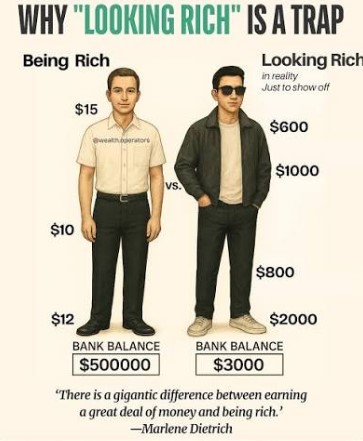
Imagine two men walking into the same shopping mall.

The first man wears a designer shirt with a massive logo, carries the latest iPhone, drives an expensive car, and makes sure everyone notices his Rolex.
The second man wears a simple shirt, carries an ordinary phone, and drives a modest car. Nobody gives him a second look.
But there is something you cannot see with riches.
The first man has monthly installments, credit card debt, and almost nothing saved.
The second man owns a profitable business, has investments, owns property, and sleeps peacefully because his financial future is secure.
Now tell me something.
Who is actually richer?
We live in a society where appearance matters more than reality. People are spending money they do not have to impress people they barely know.
And perhaps the biggest financial mistake of our generation is confusing the appearance of wealth with the reality of wealth.
The Conversation That Changed How I Look at Money as Rich
I recently watched a video featuring an elderly woman sitting on a yacht, holding a Louis Vuitton bag in one hand and a Chanel bag in the other.

She made an interesting statement:
Rich people do not necessarily need luxury brands to prove their wealth.
Initially, I found the statement amusing. After all, she was sitting on a yacht surrounded by luxury herself.
But then she shared something her father had taught her:
The moment you need people to see your money, you may already have lost sight of what money is supposed to do for you.
That thought stayed with me.
Why do we need strangers to recognize our expensive clothes? Why should the size of a logo determine how successful we appear?
And why are so many people more concerned about looking wealthy than actually becoming financially independent?
These are questions worth asking.
Luxury Brands Are Not the Enemy. Your Financial Decisions Matter.
Let’s make one thing clear.
Buying a Louis Vuitton bag, wearing a Rolex, or driving a Mercedes does not automatically mean someone is financially irresponsible.
There are genuinely wealthy people who enjoy luxury products. There is nothing wrong with that.
The problem begins when someone purchases luxury to create an image they cannot financially support.
A person earning a modest salary might take a loan to purchase the latest iPhone. Another might spend several months of savings on designer clothing simply because friends are wearing expensive brands.
Someone else might buy an expensive watch on installments just to make an impression at a wedding.
The product is not the real problem.
The motivation behind the purchase is.
There is actually an economic concept for this behavior called conspicuous consumption. It describes spending on goods partly to communicate wealth, prestige, or social status.
Interestingly, research published by the Federal Reserve found that a household’s relative income position can influence spending on high status cars, indebtedness, and financial decisions.
Read the research: Federal Reserve study on Signaling Status.
In other words, the desire to appear successful can influence financial decisions in ways people may not even recognize.
Looking Rich Can Become an Expensive Habit
Think about social media.
Someone posts a photograph outside a luxury hotel. Another shares a picture beside an expensive car. Someone else uploads a video from a first-class lounge.
Within seconds, thousands of people see the lifestyle.
But nobody sees the credit card statement.
Nobody sees the borrowed money.
Nobody sees the financial pressure behind the photograph.
Social media has created a dangerous comparison culture where people judge their own lives against carefully selected moments from somebody else’s life.
And the result?
People begin purchasing things not because they need them, but because they want to be perceived differently.
They buy clothes for compliments, cars for status, and holidays for photographs.
The question is simple:
Are you enjoying your money, or are you spending your money to create content for other people?
Rich People Think About Assets. Struggling People Often Think About Appearances.
One of the most important financial lessons is understanding the difference between an asset and a liability.
An asset is something you own that has economic value. Some assets can generate income or appreciate over time.
A liability creates a financial obligation.
A profitable business, productive investments, and income-generating property can contribute to long-term wealth.
An expensive car, designer clothing, and luxury accessories may provide enjoyment, but they generally do not build financial independence.
This does not mean everyone should stop enjoying life.
It means understanding priorities.
Before spending thousands on something that makes you look successful, ask yourself whether that money could help build something that makes you financially stronger.
The Federal Reserve Bank of St. Louis explains how savings, diversified investments, and responsible debt management contribute to building wealth.
That is a much more valuable lesson than learning which luxury brand is trending this season.
The Quiet Millionaire/Rich Is Not Always the Person You Expect
I have often observed something interesting in business gatherings.
Sometimes, the person speaking most loudly about cars, properties, expensive watches, and business achievements is not necessarily the most financially successful in the room.
Meanwhile, someone sitting quietly in a simple shalwar kameez may own businesses, employ hundreds of people, and have built wealth over several decades.
Of course, appearances can be misleading in both directions.
A quiet person is not automatically wealthy, just as someone wearing luxury brands is not automatically struggling.
But real financial strength does not require constant public approval.
A person who understands money knows that financial independence is more important than public recognition.
Wealth is not what people see when you enter a room. It is what remains when nobody is watching.
The Biggest Trap: Buying Things You Cannot Afford to Impress People You Do Not Know
Consider this situation.
You earn $2,000 per month.
You purchase a luxury watch worth $5,000 using borrowed money because you want to look successful.
Now you have an expensive watch, but you also have a financial obligation that will follow you for months or years.
What have you actually gained?
Perhaps admiration from a few people.
But what have you sacrificed?
Savings, financial flexibility, investment opportunities, and peace of mind.
A 2023 research paper published in the Journal of Economic Behavior and Organization examined the relationship between conspicuous consumption, borrowing, and inequality.
Its findings highlighted how visible status-driven spending can encourage costly borrowing, particularly among lower-income consumers.
Read: Borrowing to Keep Up with the Joneses.
This is why financial discipline matters.
You do not need to look poor to become wealthy. You do not need to reject every luxury purchase.
You simply need to stop allowing other people’s opinions to control your financial decisions.
Five Habits That Separate Building Wealth From Showing Wealth
1. Build savings before buying luxury.
Create an emergency fund and establish a savings habit. Financial security should come before unnecessary status purchases.
2. Invest in income generating opportunities.
Develop skills, build a business, explore sensible investments, and look for opportunities that can improve your financial future.
3. Stop competing with social media lifestyles.
You do not know the financial reality behind someone else’s photographs. Comparing your real life with somebody else’s online image is a losing game.
4. Avoid unnecessary debt.
Borrowing for something that depreciates simply to impress others can create long term financial pressure.
5. Buy luxury when you can genuinely afford it.
Enjoy your success. Buy the watch if you love it. Purchase the car if it fits your financial position. Just make sure your lifestyle is supported by your wealth rather than your debt.
What Does Being Truly Rich Actually Mean?
Perhaps we need to redefine the word rich.
Being rich is not necessarily owning a Ferrari.
It is having enough financial stability to make decisions without constantly worrying about the next salary.
It is being able to support your family, handle emergencies, invest in opportunities, and enjoy life without depending on borrowed money.
It is having the freedom to say no to situations that compromise your values because you are not financially desperate.
And perhaps most importantly, it is being able to sleep peacefully without worrying about maintaining an expensive image.
A person with modest clothes and financial freedom may be considerably better off than someone surrounded by luxury but drowning in debt.
Final Thought: Stop Trying to Look Rich. Start Building Wealth.
Here is something worth remembering.
Nobody will pay your electricity bill because you wear an expensive watch.
Nobody will clear your credit card debt because your Instagram photographs look luxurious.
And nobody will secure your children’s future because strangers believe you are successful.
At the end of the day, your financial decisions belong to you.
So, the next time you feel tempted to purchase something simply because you want people to notice it, pause for a moment.
Ask yourself:
Am I buying this because I genuinely want it, or because I want somebody else to think I am successful?
There is nothing wrong with enjoying luxury.
But there is something terribly wrong with sacrificing your financial future to maintain an image.
Do not spend your entire life trying to convince the world that you are rich. Build a life where you no longer need to convince anyone.
Because the ultimate luxury is not a Rolex, a Gucci bag, or a Lamborghini.
It is financial freedom.
And that is a status symbol money cannot simply buy overnight.
Recommended External References
- Federal Reserve: Signaling Status. Research on status driven spending.
- St. Louis Fed: Education, Income and Wealth. Financial literacy and wealth building.
- Research: Borrowing to Keep Up with the Joneses. Status consumption and borrowing.
What is your opinion? Do you believe wealthy people should display their success, or is real wealth better kept quiet? Share your thoughts in the comments.
About the Author
Mohammed Rizwan is a digital entrepreneur, blogger, and Founder of Blogy365. He writes about business, technology, human behavior, personal growth, and the ideas that challenge conventional thinking.
For further insights, keep visiting blogy365.com



Leave a Comment