

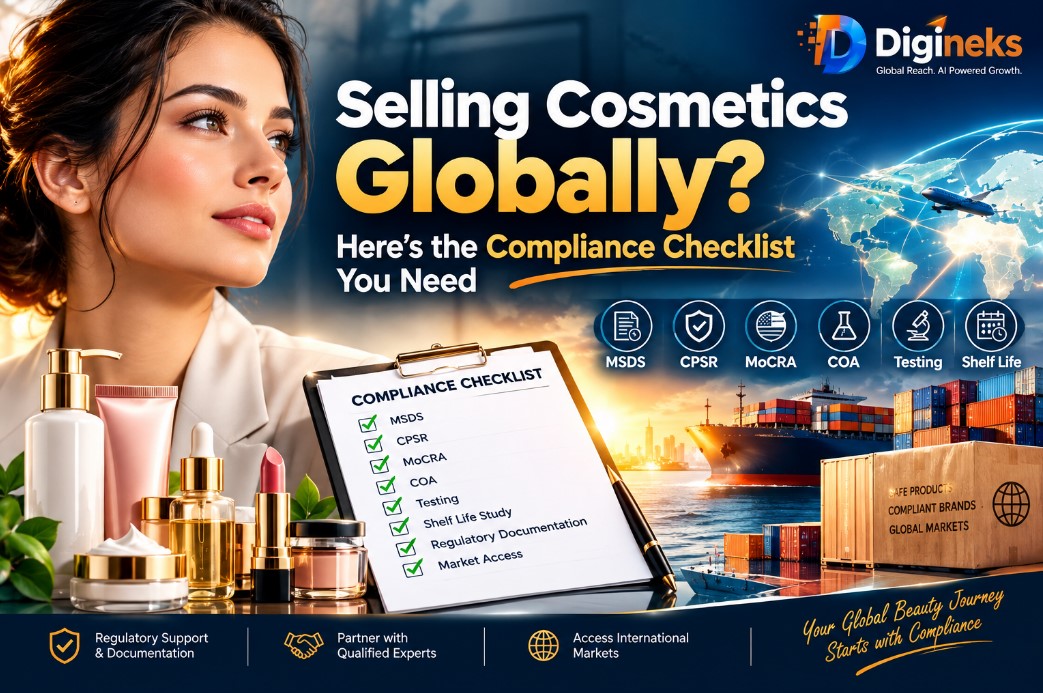

Launching a cosmetics or personal care product is no longer only about creating a beautiful formula, attractive packaging and a powerful brand.
Behind every successful product is something consumers rarely see:
MSDS, CPSR, MoCRA, COA, Testing & Shelf Life Requirements Explained

A skincare brand may have an excellent serum. A manufacturer may have a promising shampoo. A private label company may have a complete range of creams, lotions or hair care products.
But if the required regulatory documentation is incomplete, the journey into international markets can become complicated very quickly.
This is where Digineks is building a specialized regulatory and compliance support service for cosmetics and personal care businesses.
From MSDS and CPSR to COA, MoCRA support, testing requirements and shelf life studies, the goal is simple:
help businesses become better prepared for regulatory requirements and international market opportunities.
Global Cosmetics Markets Are Growing, But Compliance Matters
The cosmetics industry is highly international.
A product developed in Pakistan can potentially be sold to customers in the United States, United Kingdom, European Union, Middle East, Canada and other markets.
But every market has its own regulatory framework.

In the United States, for example, cosmetics are regulated under federal law and the FDA oversees important areas including cosmetic labeling and requirements introduced through the Modernization of Cosmetics Regulation Act, commonly known as MoCRA.
In the European Union, cosmetics are primarily governed by Regulation EC 1223/2009, which establishes requirements including product safety assessment, a responsible person and notification through the Cosmetic Products Notification Portal, or CPNP.
That means a brand thinking globally needs to think beyond marketing.
It needs a regulatory roadmap.
What Is MSDS and Why Does a Cosmetic Business Need It?
A Material Safety Data Sheet, commonly referred to as MSDS and more commonly known today as an SDS, communicates important safety information about a substance or mixture.
Depending on the product and applicable regulations, an SDS can cover information relating to hazards, composition, handling, storage, emergency measures and other safety considerations.
For businesses working with chemical substances and mixtures, safety documentation becomes an important part of the supply chain.
The European Chemicals Agency explains that SDS information helps professional and industrial users understand hazards and appropriate safety measures.
For cosmetic manufacturers, suppliers and exporters, the important point is this:
regulatory documentation needs to match the actual product, ingredients, classification and destination market.
That is why generic documents can create problems.
CPSR: A Critical Part of European Cosmetic Compliance
For businesses targeting the European market, the Cosmetic Product Safety Report, or CPSR, is an important component of the regulatory process.
Under the EU Cosmetics Regulation, manufacturers need to meet specific safety requirements and prepare a product safety report before placing a cosmetic product on the EU market.

A proper safety assessment can involve information such as:
Ingredient information
Product formulation
Toxicological considerations
Exposure considerations
Product characteristics
Microbiological information
Packaging considerations
Safety conclusions
A CPSR is therefore much more than simply putting a logo on a certificate.
It is part of the scientific and regulatory documentation supporting the safety of the cosmetic product.
MoCRA Has Changed the U.S. Cosmetics Compliance Landscape
For brands targeting the United States, one of the biggest regulatory developments in recent years is MoCRA, the Modernization of Cosmetics Regulation Act of 2022.
Under MoCRA, applicable cosmetic facilities generally have registration requirements, while responsible persons have product listing responsibilities. FDA also requires safety substantiation records for cosmetic products.
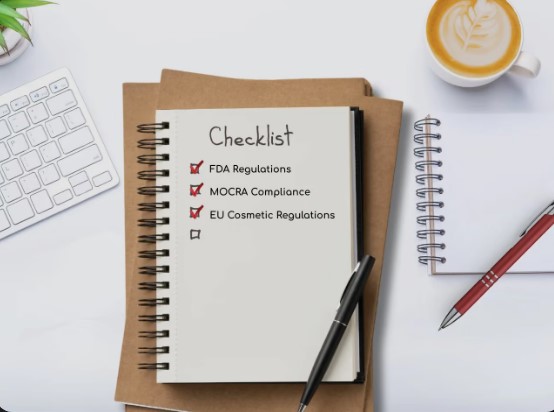
FDA states that facility registration generally needs renewal every two years, while cosmetic product listings require annual updates.
There is another important point that many businesses misunderstand.
FDA cosmetic facility registration is not the same thing as FDA product approval.
In fact, FDA recently clarified that it does not issue certificates or verification documents proving cosmetic facility registration or product listing.
That distinction matters enormously for exporters and brands.
A professional compliance service should therefore help a business understand what a regulatory requirement actually means instead of simply selling a document.
COA: Understanding the Certificate of Analysis
A Certificate of Analysis, or COA, provides analytical information relating to a material or product.
Depending on the product, testing program and laboratory, this can include parameters such as:
Identity
Purity
Physical characteristics
Microbiological results
Chemical parameters
Batch information
Specification limits
Test results
For cosmetic manufacturers and suppliers, the COA can become an important part of quality documentation and supplier communication.
The key is ensuring that the COA reflects the actual specification and testing performed.
Cosmetic Product Testing: What Does Your Product Actually Need?
One of the biggest mistakes new cosmetic brands make is asking:
“What test certificate do I need?”
The better question is:
“What testing is appropriate for this particular product and target market?”
Different products can have different testing considerations.
Depending on the formulation and intended use, businesses may need to consider areas such as:
Microbiological testing
Stability testing
Preservative effectiveness testing
Packaging compatibility
Physical and chemical testing
Safety assessment data
Product specific testing
Claims substantiation
The exact requirements depend on the product, formulation, claims, packaging, market and applicable regulations.
FDA itself notes that while specific cosmetic tests are not universally prescribed by law, manufacturers and marketers have responsibility for ensuring product safety and maintaining adequate safety substantiation.
That is why testing should be planned rather than purchased randomly.
Shelf Life Studies: How Long Will Your Product Remain Suitable?
A cosmetic product may look perfect when it leaves the manufacturing facility.
The real question is:
What happens after months of storage?
Temperature changes, humidity, packaging interaction, microbial growth, oxidation and formulation instability can affect product quality.
Shelf life and stability work can help businesses understand how a product behaves over time under defined conditions.
Interestingly, U.S. cosmetic law does not generally require cosmetic manufacturers to print expiration dates on labels, but FDA emphasizes the manufacturer’s responsibility for product safety.
For brands expanding internationally, stability information can therefore become an important part of a broader product documentation strategy.
EU Cosmetics Compliance Goes Beyond One Document
A company entering the European market should not think:
“We have a CPSR, so we are finished.”
The European regulatory framework involves several connected responsibilities.
These can include:
Product safety assessment
Responsible Person
Product Information File
Ingredient compliance
Labeling
Claims
CPNP notification
Serious undesirable effect procedures
Nanomaterial requirements where applicable
The European Commission confirms that products placed on the EU market need an appropriately designated responsible person and that cosmetic products are notified through CPNP.
This is why regulatory compliance should be approached as a system, not a collection of disconnected documents.
How Digineks Can Help Cosmetics and Personal Care Brands
This is where the new Digineks service offering comes in.
Digineks combines digital business expertise with regulatory and compliance support to help cosmetics and personal care businesses organize the documentation and market readiness process.
The service portfolio can include support for:
MSDS and SDS Documentation
Safety documentation for applicable substances and mixtures.
CPSR Support
Cosmetic Product Safety Report coordination and documentation support for applicable markets.
COA Support
Certificate of Analysis coordination and analytical documentation.
MoCRA Support
Support with understanding and preparing applicable U.S. cosmetic regulatory requirements.
Testing Coordination
Helping brands identify appropriate testing requirements and coordinate with relevant laboratories.
Shelf Life and Stability Support
Helping businesses determine appropriate stability and shelf life study requirements.
Regulatory Documentation
Organizing the documentation needed to move a cosmetic product toward market readiness.
International Market Support
Helping brands understand the regulatory documentation landscape before approaching international markets.
The important positioning here is support and coordination, with qualified laboratories, safety assessors and regulatory professionals handling areas that require specialized technical or legal responsibility.
From Product Idea to Market Ready Brand
Imagine a Pakistani cosmetic manufacturer developing a new skincare product.
The manufacturer has:
A formulation
Packaging
A brand name
A manufacturing facility
A target customer
But now they want to sell internationally.
The questions begin.
Is the formulation compliant?
What documentation is required?
Does the product need an SDS?
Does it need a CPSR?
What testing should be performed?
What about stability?
What does the U.S. market require?
Does MoCRA apply?
What does the European market require?
What labeling information is necessary?
Who coordinates the documentation?
This is the gap Digineks wants to address.
Not just digital marketing.
Not just documentation.
But a bridge between product development, regulatory preparation and market access.
Why Regulatory Support Can Become a Major B2B Opportunity
There is an interesting business opportunity hiding behind cosmetics.
Thousands of manufacturers and emerging brands want to export.
Many have excellent products.
Many understand manufacturing.
Many understand social media.
But regulatory documentation can become a completely different world.
That creates an opportunity for specialized service providers.
Digineks already operates at the intersection of technology, digital marketing, AI and business consulting.
Adding regulatory and compliance support creates another B2B entry point.
A client may initially contact Digineks for an MSDS.
That relationship can potentially develop into:
CPSR support
Testing coordination
Regulatory documentation
Website development
SEO
International digital marketing
Lead generation
Ecommerce development
AI customer support
WhatsApp automation
This is where the model becomes much more interesting.
One regulatory client can become a long term business client.
Compliance Meets Digital Growth
Regulatory compliance gets a product ready for a market.
Digital marketing helps people discover that product.
These two activities can work together.
A cosmetic brand entering the UK or U.S. market may need both:
Regulatory readiness
and
market visibility.
That creates a powerful opportunity for Digineks.
A brand could potentially receive regulatory documentation support while also getting help with:
SEO
Website development
Google Business optimization
Social media
Content marketing
Paid advertising
AI customer support
WhatsApp automation
Lead generation
This makes Digineks more than a conventional documentation provider.
It positions the company as a growth partner for emerging brands.
The Bigger Strategy Behind Digineks
Here is what I would focus on if I were building this vertical aggressively.
Do not market Digineks simply as:
“We make MSDS and CPSR.”
That becomes a price comparison business.
Instead position it around a larger promise:
From Documentation to Market Access.
The customer is not buying a PDF.
The customer is trying to get a product ready for business.
That difference changes everything.
You can build dedicated landing pages for:
Cosmetic MSDS Services
CPSR Services
MoCRA Compliance Support
Cosmetic COA Services
Cosmetic Product Testing
Shelf Life Study Requirements
EU Cosmetic Compliance
USA Cosmetic Compliance
Cosmetic Regulatory Consulting
Each page can target a specific search intent and link naturally to the others.
That creates an SEO ecosystem around Digineks rather than relying on one article.
Useful Regulatory Resources for Cosmetic Businesses
Businesses should always verify regulatory requirements using authoritative sources.
For U.S. cosmetics, the U.S. Food and Drug Administration provides official information on cosmetic labeling, MoCRA, facility registration and product listing.
FDA Cosmetics Regulatory Information
For European cosmetics, the European Commission provides information about Regulation EC 1223/2009 and the Cosmetic Products Notification Portal.
European Commission Cosmetics Regulation
For chemical safety and SDS information in Europe, businesses can consult the European Chemicals Agency.
The Future Belongs to Market Ready Brands
A beautiful cosmetic product is only the beginning.
The brands that want to compete internationally need to think about formulation, testing, documentation, labeling, safety, compliance and marketing together.
That is the opportunity.
Digineks is building a specialized support model for cosmetics and personal care businesses that want to move from product development toward regulatory readiness and international market opportunities.
From MSDS and CPSR to COA, MoCRA support, testing coordination and shelf life studies, the objective is simple:
Help businesses prepare better.
Help products move further.
Help brands build for global markets.
And that fits perfectly with the Digineks vision:
Global Reach. AI Powered Growth.
For further insights, keep visiting blogy365.com



Leave a Comment