


A tiny piece of metal sits quietly in millions of homes around the world. It holds clothes together, secures fabric, appears in first aid kits, and has become one of those objects people rarely think about.
But the story behind it is extraordinary.
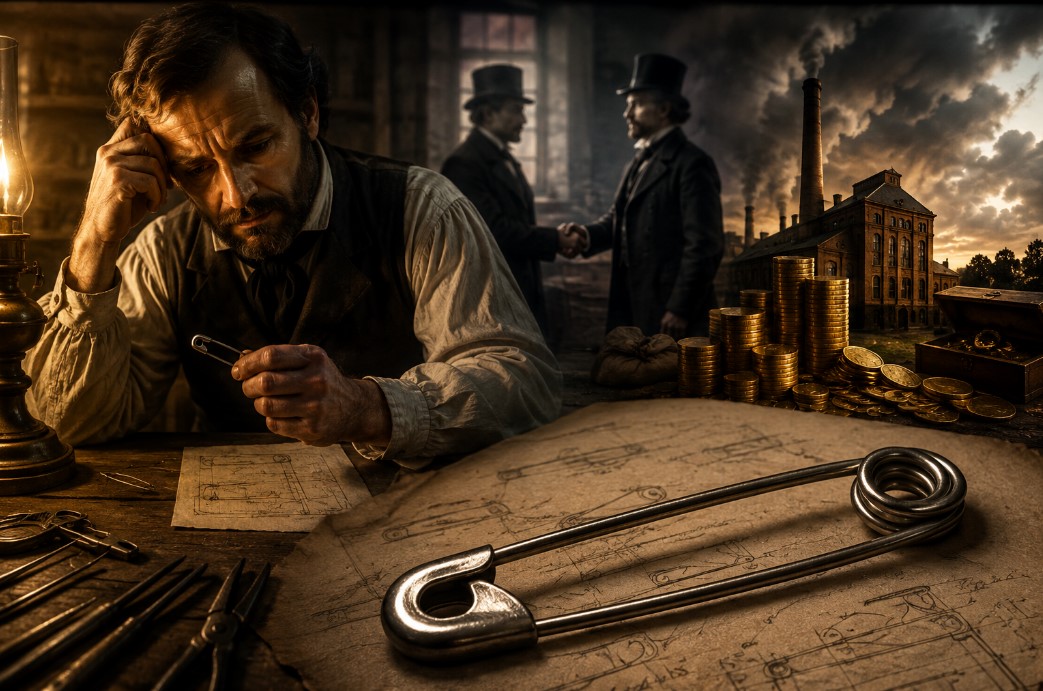
In 1849, American inventor Walter Hunt was dealing with something far less glamorous than changing the world. He needed money to settle a $15 debt.
What happened next turned an ordinary piece of wire into one of the most recognizable everyday inventions in history.
And Hunt would make a decision that would leave him with only a small share of the fortune his invention could eventually generate.
A $15 Problem Created a World-Famous Invention: the Safety Pin
Walter Hunt was a mechanic and prolific inventor from New York. According to the National Inventors Hall of Fame, he was working with a piece of wire while thinking about how to repay a $15 obligation.
That moment of financial pressure sparked an idea.
Instead of simply using the wire as it was, Hunt began bending and twisting it into a more practical fastening device.
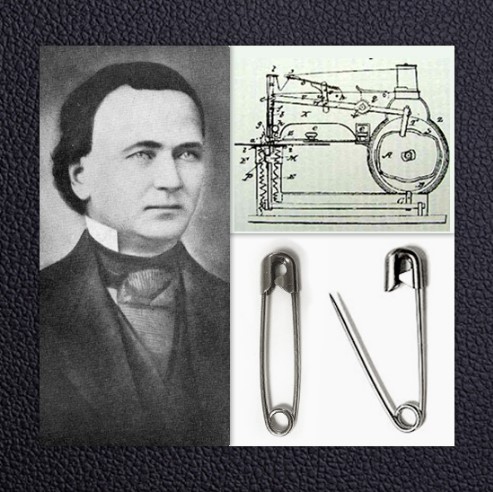
The result was a clever design that combined three important elements: a pointed pin, a spring created by the coiled wire and a clasp that protected the sharp point.
His design became the foundation of the modern safety pin.
How Walter Hunt Designed the Safety Pin
The brilliance of Hunt’s invention was its simplicity.
The entire mechanism could be made from a single piece of wire. The wire could be shaped into a spring, while the end formed a clasp capable of holding the sharp point securely.
That solved an obvious problem with ordinary pins.
A traditional pin could easily open unexpectedly and injure someone. Hunt’s design created a protective mechanism that kept the point contained when the pin was closed.
The original patent described the invention as a dress pin made from one piece of wire or metal, incorporating a spring and a catch.
This was not an invention that needed complicated machinery or expensive materials.
It was elegant mechanical thinking applied to an everyday problem.
The $400 Decision That Changed Everything
On April 10, 1849, Walter Hunt received U.S. Patent No. 6,281 for his invention.
But Hunt did not spend the rest of his life building a safety pin empire.
He sold the patent rights for $400.
That was enough to deal with his $15 debt and left him with money in hand. But he did not continue collecting royalties as the invention spread into everyday life.
History would remember the safety pin.
It would not make Walter Hunt rich.
Both the National Inventors Hall of Fame and HISTORY document that Hunt sold the rights for $400 and did not go on to receive the enormous financial benefits that later commercial success could have produced.
The Patent Was More Clever Than It Looks
Hunt’s original patent is fascinating because it reveals exactly what made the design different.
The patent describes a pin combining a spring and clasp in one piece of wire. The spring provided tension while the clasp securely retained the point.
It also emphasized another important advantage: the design avoided the separate joint or hinge found in other fastening mechanisms.
You can examine the original 1849 patent through Google Patents: Walter Hunt’s Safety Pin Patent.
Reading the original document makes one thing clear.
The safety pin was not merely a bent piece of wire. It was a carefully considered mechanical solution.
Was Walter Hunt Really the First Person to Invent the Safety Pin?
There is an important historical detail here.
Hunt’s invention was not the first object in human history resembling a pin used to fasten things. Earlier fastening devices existed, including ancient forms used for clothing and jewelry.
What Hunt patented in 1849 was an improved safety pin design, particularly its combination of a spring mechanism and protective clasp.
HISTORY notes that another version had appeared in 1842 but lacked the spring mechanism associated with Hunt’s design.
So the more accurate claim is that Walter Hunt developed and patented the safety pin design substantially similar to the one we recognize today.
From Financial Pressure to Everyday Essential
The safety pin eventually became useful far beyond the problem that inspired it.
It could fasten clothing, secure fabric, help with household repairs and become a useful item in emergency and first aid kits.
The National Inventors Hall of Fame notes that Hunt’s invention went on to have numerous everyday applications.
That is what makes the story so interesting.
Hunt was not trying to create an iconic household object.
He needed $15.
A financial problem pushed him toward an invention that would outlive him by generations.
Walter Hunt Had More Ideas Than the Safety Pin
The safety pin was only one chapter in Hunt’s remarkable career.
He worked on numerous inventions and received patents for different devices, including machinery, a fountain pen, and other practical tools.
He also developed an early sewing machine, although he did not patent that machine at the time. The National Inventors Hall of Fame describes Hunt as a prolific inventor who continued creating throughout his life.
This makes his story even more intriguing.
Hunt was not someone who accidentally invented one useful object.
He was constantly trying to solve practical problems.
The Bigger Lesson Behind a Tiny Safety Pin
There is a business lesson hidden inside Walter Hunt’s story.
An invention is not automatically a fortune.
The person who creates an idea and the person who commercializes that idea do not always become the same person.
Hunt solved the engineering problem.
Someone else could take the commercial opportunity.
That distinction still matters today.
Entrepreneurs, engineers, and creators can spend years developing something valuable, yet the financial reward may ultimately depend on patents, licensing, manufacturing, distribution, marketing, and business strategy.
Hunt’s $400 decision is therefore more than an interesting historical footnote.
It reminds us that creating value and capturing value are two different things.
🧷 The $15 Debt That Became a Lasting Legacy
Walter Hunt died in 1859, only a decade after patenting his famous dress pin.
He never saw the safety pin become the ubiquitous household object it would eventually become.
Yet his invention survived.
More than 150 years later, the basic concept remains instantly recognizable.
The National Inventors Hall of Fame inducted Walter Hunt in 2006 for the safety pin.
That is perhaps the most remarkable part of the entire story.
Hunt needed money for a small financial problem.
He created a solution using a simple piece of wire.
He sold the rights for $400.
The world kept using his invention long after his name faded from everyday conversation.
Important: I would avoid saying Hunt specifically lost or missed millions of dollars unless we can establish a reliable historical calculation. The stronger and safer claim is that the invention later generated substantial commercial value while Hunt received only the $400 sale price and no further royalties.
🔗 Read the Original Sources
For readers who want to explore the history further, the original patent and authoritative historical accounts are available through Google Patents, National Inventors Hall of Fame and HISTORY’s account of Walter Hunt and the safety pin.
For further insights, keep visiting blogy365.com



Leave a Comment