

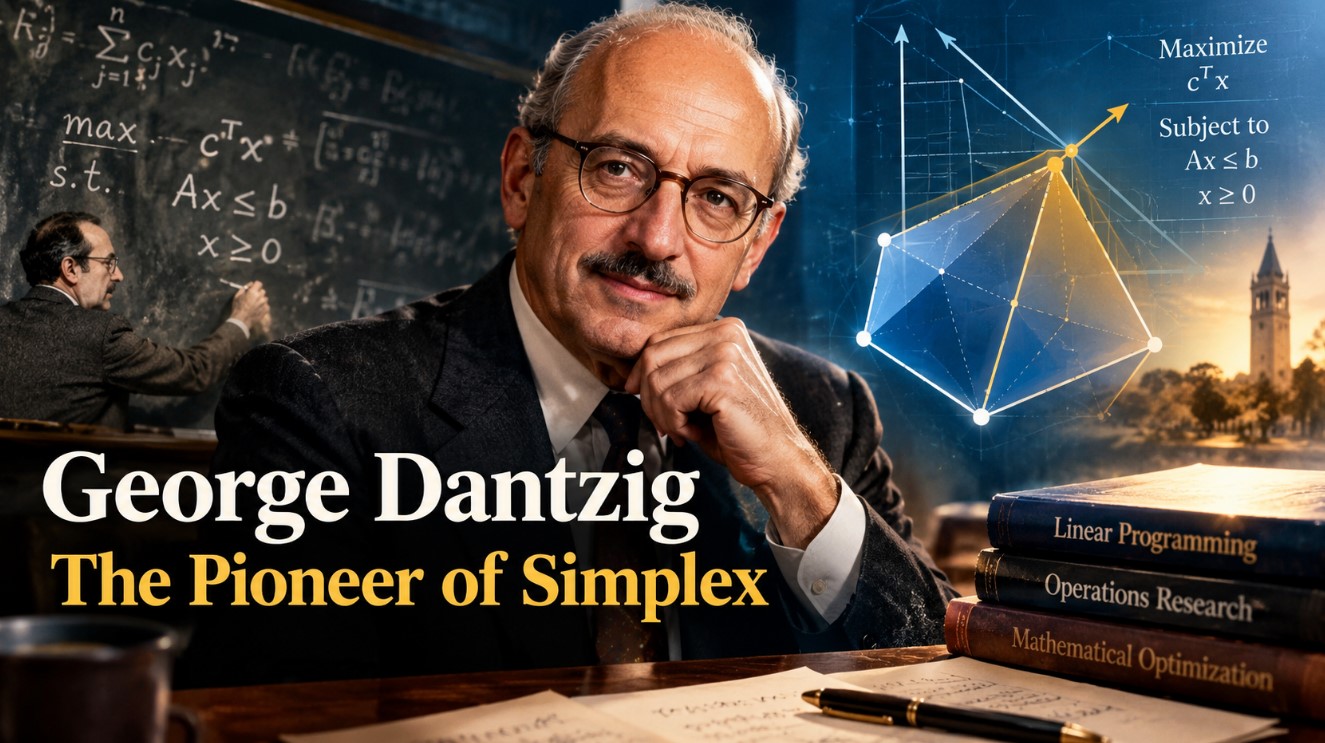

Discover George Dantzig’s inspiring story, the famous unsolved math problems he solved, and how he developed the simplex method to transform optimization.
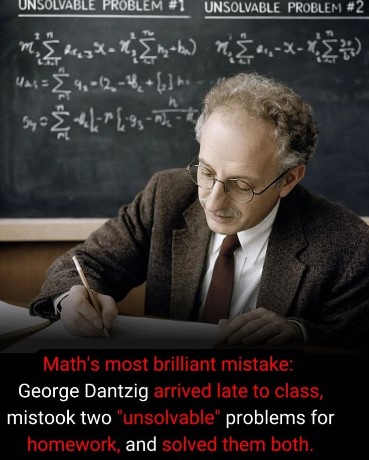
Then you discover something extraordinary.
Those problems were not ordinary homework. They were problems that leading mathematicians had struggled to solve.
That is the remarkable story associated with George B. Dantzig, one of the most influential mathematicians of the twentieth century. But his story did not end with that surprising classroom experience. He went on to develop the simplex method, a mathematical technique that transformed how organizations approach complex decisions involving costs, resources, production, and planning.
His journey offers an important lesson for students, entrepreneurs, professionals, and anyone who has ever doubted their abilities. Sometimes, what looks impossible is simply a problem you have not yet learned to approach.
Read Also: Success Story of Mohammed Ali Tabba
Who Was George B. Dantzig?
George Bernard Dantzig was born on November 8, 1914, in Portland, Oregon, in the United States. He became a mathematician, statistician, academic, and pioneer of operations research.
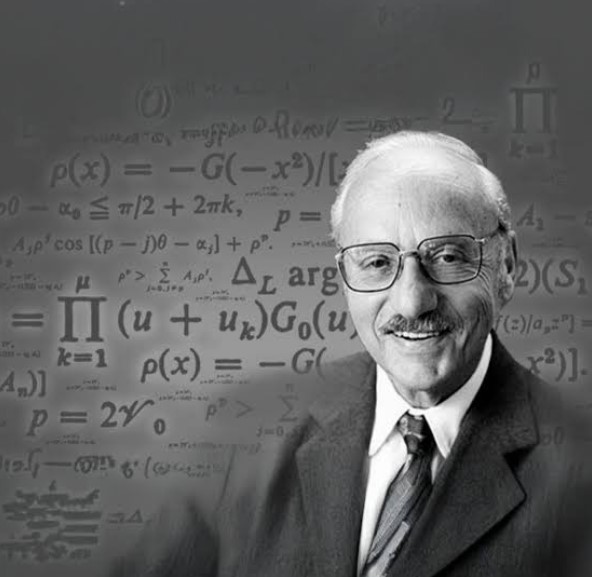
His work helped establish the foundations of linear programming, a mathematical approach to finding the best possible outcome when resources and other conditions impose limits.
Dantzig studied at the University of Maryland and later pursued graduate studies at the University of California, Berkeley. His academic career eventually took him to Stanford University, where he became a professor of operations research and computer science.
He was widely recognized for his contribution to mathematical optimization, particularly the simplex algorithm, which became an important tool for solving practical planning problems.
According to Stanford University, his work influenced fields ranging from petroleum refining to airline scheduling.
His life demonstrates that mathematics is not merely about numbers on a page. Used well, it can help people make better decisions in the real world.
Read Also: The Future of Work
The Classroom Mistake That Became a Legendary Story of Dantzig
The story that made George Dantzig famous among generations of students began during his graduate studies at Berkeley.
One day, Dantzig arrived late for a statistics class taught by Professor Jerzy Neyman. He noticed two mathematical problems written on the blackboard.
Assuming they were homework assignments, he copied them down.
The problems appeared unusually difficult, but he approached them as he would any other academic challenge. He worked on them, developed solutions, and eventually submitted his work.
Only later did he learn that the problems were famous, previously unsolved statistical problems.
What he had mistaken for homework was a serious mathematical challenge.
The incident became one of the most widely retold stories in the history of mathematics. It even inspired a scene in the film Good Will Hunting.
However, the important point is not that Dantzig solved the problems without effort. He was already a capable mathematician who had spent years studying his subject. The surprising part was that he did not know the problems had defeated other researchers.
That lack of awareness changed his perception of the task, but his knowledge and persistence did the actual work.
Why This Story Of Dantzig Matters Today
Many people decide something is impossible before they have genuinely tried it.
A student sees a difficult examination question and assumes failure is inevitable. An entrepreneur sees an established competitor and believes entering the market is pointless. An employee faces an unfamiliar responsibility and doubts their ability to learn it.
Read Also: The Business Dream
Dantzig’s experience encourages a different response.
Before deciding that a challenge is beyond your ability, understand the problem, make a serious attempt, and give yourself room to learn.
Confidence does not mean believing every task will be easy. It means being willing to work through difficulty without immediately surrendering.
The Simplex Method: A Different Kind of Breakthrough
Dantzig’s most significant mathematical contribution was separate from the classroom incident.
In 1947, while working on planning problems for the United States Air Force, he developed the simplex method for solving linear programming problems.
The military needed better ways to organize complicated plans involving personnel, equipment, supplies, training, and other limited resources. Manual planning could become difficult when numerous activities competed for the same resources.
Dantzig recognized that many of these challenges could be represented mathematically.
Instead of relying entirely on trial and error, planners could describe their objectives, define their constraints, and use mathematical methods to identify an efficient solution.
The simplex method became one of the central techniques for solving these problems.
It is important to understand what the word programming meant in this context. It referred to planning and scheduling, not writing modern computer software.
The idea was powerful: translate a practical decision into a mathematical model, then systematically search for a solution that satisfies the requirements and improves the desired outcome.
What Is Linear Programming?
Linear programming is a mathematical method used to optimize an objective while respecting a set of constraints.
The objective might be to maximize profit, minimize cost, reduce waste, or make the best use of available resources.
The constraints might include a limited budget, available working hours, production capacity, raw materials, transportation limits, or minimum requirements.
Consider a factory that produces two products. Each product generates a different profit and consumes different amounts of labor and raw materials. The factory cannot produce unlimited quantities because its resources are limited.
Linear programming can help determine the combination of products that produces the best result under those constraints.
The simplex method is one established technique for solving this class of mathematical problem.
This is where Dantzig’s work moved beyond theoretical mathematics. It offered a practical way to improve real decisions.
How the Simplex Method Of Dantzig Works
At a basic level, the process begins with a clearly defined objective and a set of constraints.
The mathematical model represents the available choices and the limits that govern them. The simplex method then moves between candidate solutions in a systematic way, improving the objective while maintaining feasibility, until an optimal solution is reached under the model’s assumptions.
For a student, this may sound abstract. For a business, the practical implications can be substantial.
Imagine a manufacturer with limited raw materials, a fixed production budget, and several products to make. The company wants to determine the best production plan.
A mathematical optimization model can help answer questions such as:
- How many units of each product should be manufactured?
- Which resource is limiting production?
- How can the available budget be used most effectively?
- What production plan offers the greatest profit under the stated constraints?
The simplex method provides a systematic mathematical approach to solving suitable models of this kind.
Real problems still require reliable data, sensible assumptions, and careful interpretation. An optimal mathematical answer is only as useful as the model and information behind it.
Five Important Benefits of the Simplex Method of Dantzig
1. Better Use of Limited Resources
Organizations rarely have unlimited money, staff, materials, or time.
The simplex method can help identify how resources should be allocated to achieve a defined objective. This is especially valuable when several competing activities must share the same limited capacity.
2. Lower Costs and Less Waste
A business may need to meet production targets while minimizing material costs, transportation expenses, or other operating costs.
Linear programming can help identify combinations of activities that satisfy the necessary requirements at lower cost.
The actual savings depend on the quality of the model and the decisions made from its results.
3. More Informed Production Planning
Manufacturers can use linear programming to plan product quantities, allocate machine capacity, and coordinate the use of raw materials.
Rather than making decisions based only on intuition, managers can compare alternatives mathematically.
4. Improved Logistics and Scheduling
Transportation and logistics involve competing demands, limited capacity, and multiple possible routes or schedules.
Optimization techniques can help organizations plan shipments, coordinate resources, and improve the efficiency of suitable logistics systems.
5. Clearer Business Decisions
The greatest value of optimization is not simply obtaining a number. It is understanding how a decision performs under specific constraints.
A well designed model helps managers compare options, identify limitations, and explain why one plan is preferable to another.
These benefits extend beyond large corporations. The underlying principle of defining an objective and making the best use of limited resources is relevant to businesses of many sizes.
Where Is the Simplex Method Used Today?
The influence of linear programming extends across many industries.
Manufacturing: Businesses use optimization models to plan production, allocate materials, and improve capacity utilization.
Airlines and transportation: Optimization techniques support scheduling, resource allocation, and related operational planning problems.
Energy and petroleum: Linear programming has been used in refinery planning, production decisions, and the allocation of energy resources.
Agriculture and food planning: Models can help determine suitable combinations of crops, ingredients, or foods under resource and cost constraints.
Finance and investment: Linear programming can support certain portfolio allocation and financial planning problems, subject to appropriate assumptions and constraints.
Supply chains: Organizations can model inventory flows, production quantities, and distribution decisions to improve the use of available resources.
Not every problem in these industries can be solved with the simplex method alone. Some require other optimization algorithms, simulation, or more advanced mathematical techniques. Nevertheless, Dantzig’s work helped establish a foundation for modern operations research.
George Dantzig’s Success Was Bigger Than One Classroom Incident
It would be easy to tell this story as though one accidental misunderstanding made Dantzig successful overnight.
That would miss the real achievement.
The classroom incident was memorable, but his wider career involved years of mathematical research, difficult practical problems, and sustained professional work.
His development of the simplex method came from a different challenge: finding a systematic way to improve planning and resource allocation.
Dantzig continued to contribute to mathematics, computer science, economics, and operations research. He became a professor at Stanford University in 1966 and received the United States National Medal of Science in 1975.
He died on May 13, 2005, leaving a legacy that continues to influence mathematical optimization.
His achievements were not the result of a single lucky moment. They reflected the combination of knowledge, persistence, intellectual curiosity, and an ability to connect mathematical theory with real problems.
That distinction matters because inspiration is most useful when it helps us understand what success actually requires.
What Students Can Learn From George Dantzig
Do Not Underestimate Yourself Before You Begin
Dantzig did not know that the problems on the blackboard were considered exceptionally difficult. He focused on solving them rather than on their reputation.
Students can apply the same principle by attempting challenging questions before deciding they are beyond their ability.
This does not guarantee success every time. It creates opportunities to learn that fear might otherwise close off.
Build Knowledge Before You Need It
Dantzig’s ability to solve difficult mathematical problems depended on his existing education and skills.
Preparation often looks ordinary while it is happening. Reading, practicing, asking questions, and learning from mistakes may not produce immediate recognition, but these habits create the foundation for future achievements.
Treat Difficulties as Problems to Understand
A complicated challenge becomes easier to approach when it is broken into smaller questions.
What exactly needs to be achieved? What information is available? What limits must be respected?
This approach works in mathematics, business, professional life, and everyday decision making.
Stay Curious
Curiosity encourages people to investigate unfamiliar subjects and question assumptions.
Dantzig’s career shows the value of combining that curiosity with technical skill and disciplined work.
Turn Knowledge Into Practical Value
The simplex method mattered because it helped address real planning problems.
For entrepreneurs and professionals, this is a particularly valuable lesson. Knowledge becomes more useful when it helps solve a genuine problem for other people.
What Entrepreneurs Can Learn From the Simplex Method
Dantzig’s work has a direct lesson for business owners, particularly those building companies with limited budgets and resources.
A business owner constantly makes allocation decisions.
Should more money go toward marketing or product development? Which products deserve priority? How many orders can the business handle? How should a limited workforce be assigned? Which activity delivers the greatest return?
These questions resemble optimization problems, even when they cannot be represented perfectly by a simple linear model.
An entrepreneur can begin by following five practical steps.
First, define the objective. Decide what success means. It might be higher profit, lower costs, more customers, or faster delivery.
Second, identify the constraints. List the actual limits involving money, staff, time, materials, and capacity.
Third, collect reliable information. Record costs, sales, resource requirements, and other relevant figures instead of relying on unsupported assumptions.
Fourth, compare alternatives. Examine different ways to use the available resources and estimate the results of each option.
Fifth, review the outcome. Compare the plan with actual performance, and update assumptions as conditions change.
A small business does not necessarily need advanced mathematical software to benefit from this way of thinking. Even a well-maintained spreadsheet can help organize decisions and expose waste.
The important lesson is to stop treating every decision as an isolated guess. Understand the objective, respect the constraints, and compare the alternatives.
Was George Dantzig’s Story the Inspiration for Good Will Hunting?
The classroom story associated with Dantzig is often compared with the famous mathematical scene in Good Will Hunting.
Both involve a person encountering a problem that others regard as exceptionally difficult and producing an unexpected solution.
However, the fictional story and the historical events should not be treated as identical. Dantzig’s real achievement involved statistical problems during his graduate studies, followed later by his development of the simplex method for linear programming.
The movie offers a dramatic interpretation of extraordinary mathematical ability. Dantzig’s actual career provides a more detailed lesson about the relationship between talent, preparation, and sustained work.
For readers interested in the history behind the story, the University of California, Berkeley, has published a useful account of Dantzig’s life and achievements.
The Deeper Lesson: A Mistake Can Change Your Perspective, but Work Creates Results
There is a reason the story of George Dantzig continues to inspire people.
He encountered two difficult problems without realizing how significant they were. His willingness to work on them led to an unexpected academic achievement.
Later, he addressed a different challenge and developed the simplex method, helping establish a mathematical approach to complex planning and resource allocation.
These events offer two related but distinct lessons.
The first is about perception. We sometimes place unnecessary limits on ourselves because we believe a task is impossible before we have properly examined it.
The second is about application. Important breakthroughs often emerge when people combine knowledge with a serious attempt to solve a real problem.
Neither lesson suggests that success comes easily or that confidence alone is enough. Both encourage people to approach difficulty with preparation, patience, and a willingness to think.
For students, that may mean attempting a challenging problem instead of giving up immediately.
For entrepreneurs, it may mean testing a new idea instead of rejecting it because the market appears crowded.
For professionals, it may mean learning a new skill or finding a better way to complete an established task.
The circumstances will differ, but the underlying principle remains useful.
Final Thoughts
George B. Dantzig’s life reminds us that remarkable achievements are not always recognized at the moment they begin.
A classroom misunderstanding became a legendary mathematical story. Years of serious work produced the simplex method, an important contribution to optimization and operations research. His ideas helped organizations approach difficult decisions involving resources, costs, and competing objectives.
His legacy is not a promise that every mistake will lead to success. It is a reminder that an unexpected opportunity can become meaningful when it meets preparation, curiosity, and hard work.
The next time you face a difficult problem, resist the temptation to decide too quickly that it cannot be solved.
Understand it. Break it into smaller parts. Use what you know. Learn what you do not know. Then make a serious attempt.
You may not discover a mathematical breakthrough, but you can develop the habits that make progress possible.
Sometimes, the first step toward a better answer is simply refusing to assume that the problem is beyond you.
Sources and Further Reading
- Stanford University, George Dantzig and his contribution to operations research: https://engineering.stanford.edu/about/history/heroes/2012-heroes/george-dantzig
- University of California, Berkeley, George Dantzig: Operations Research Phenom: https://engineering.berkeley.edu/george-dantzig-operations-research-phenom/
- INFORMS, Who Was George B. Dantzig?: https://www.informs.org/Recognizing-Excellence/INFORMS-Prizes/George-B.-Dantzig-Dissertation-Award/Who-Was-George-B.-Dantzig
- National Medal of Science Foundation, George B. Dantzig: https://nationalmedals.org/laureate/george-b-dantzig/
- MacTutor History of Mathematics, Biography of George Dantzig: https://mathshistory.st-andrews.ac.uk/Biographies/Dantzig_George/
- Blogy365.com



Leave a Comment