


When Verizon’s network went dark on Wednesday, it was not just dropped calls and lost signals. For thousands of users, phones slipped into SOS mode, and something far more serious came into question. Could people reach 911 when they needed it most?
That single concern turned a routine outage into a national conversation about emergency preparedness and telecom reliability.
📵 What Actually Happened During the Verizon Outage 911
Verizon confirmed that its mobile network experienced a widespread disruption that lasted for several hours. Service was officially restored at 10:20 p.m. Eastern Time.
During the outage, many users reported that their phones showed SOS mode. This usually means normal calls and data are unavailable, but emergency calls should still go through by connecting to any available network tower.
In theory, this safeguard exists to protect users in critical moments. In reality, things did not go as smoothly.
Latest Update on Network Outage
☎️ Why 911 Calls Were Affected for Some Users
Several Verizon customers reported difficulty connecting to 911 during the outage. While emergency calls are designed to bypass carrier limitations, multiple local emergency service departments issued alerts warning residents that 911 calls might not connect reliably.
Some agencies advised people to use landlines, non-emergency numbers, or official social media pages to request help until mobile services stabilised.
This raised serious questions about the resilience of emergency call systems during large-scale carrier failures.
🧠 How Emergency Call 911 Routing Is Supposed to Work
Under normal circumstances, 911 calls can connect through any nearby cellular tower, regardless of the user’s carrier. This system is designed to ensure access even when a specific network is down.
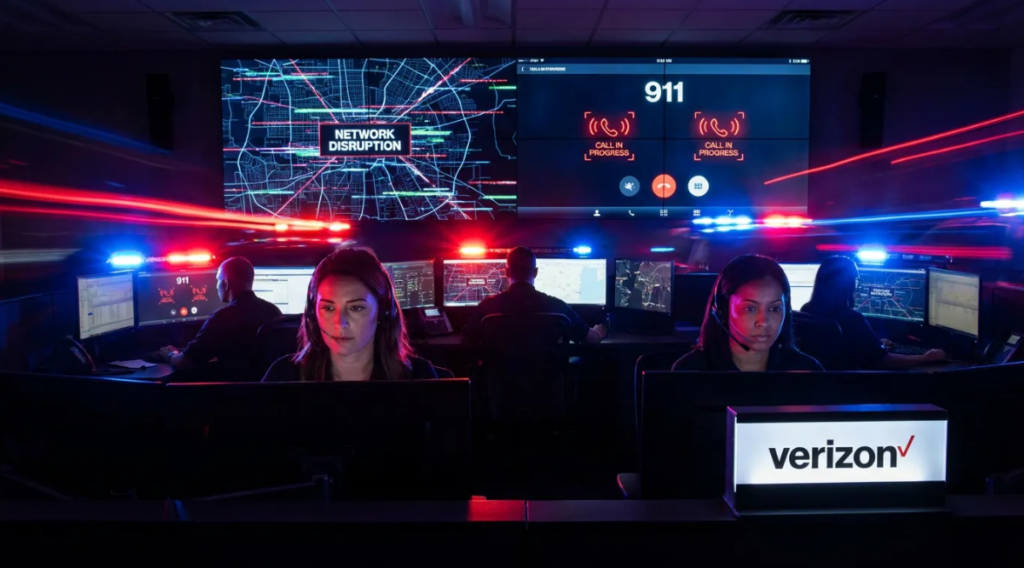
According to the Federal Communications Commission, wireless providers are required to prioritise emergency communications and maintain redundancy where possible. You can read more about these requirements on the FCC’s official website.
What this outage revealed is not necessarily a single failure point, but the fragile complexity of systems we often assume are bulletproof.
🏛️ Official Responses and Public Warnings
Emergency management offices in several regions publicly acknowledged the issue. Some posted warnings urging residents not to rely solely on mobile phones during the outage.
Verizon later stated that services had been restored and that they were investigating the root cause. A deeper explanation is expected, similar to past analyses published by outlets like CNN and The Verge, which frequently cover telecom infrastructure failures.
For a broader breakdown of what is known and what remains unclear, you can also reference coverage from Mashable and Reuters
Read This also: Continuously happening in the USA.
🔍 The Bigger Lesson for Users and Providers
Here is what matters. This was not just a Verizon problem. It exposed how dependent modern life is on invisible systems that rarely get tested under stress.
For users, it is a reminder to know alternative ways to reach emergency services. For providers, it is a wake-up call to strengthen redundancy and transparency.
When emergency access is even briefly uncertain, trust takes a hit. Rebuilding that trust requires more than restored signal bars.
⚠️ What You Should Do During Network Outages
If you ever face a similar situation, keep these basics in mind.
Try calling 911 even if your phone shows SOS mode
Use a landline if available
Check local police or fire department social media pages
Save non-emergency numbers for your area in advance
Preparation beats panic every time.
📌 Final Thoughts
The Verizon outage may be over, but the conversation it triggered should not be. Emergency access is not a luxury. It is a promise. When that promise wavers, even briefly, it deserves scrutiny, accountability, and better systems going forward.
Leave a Comment