

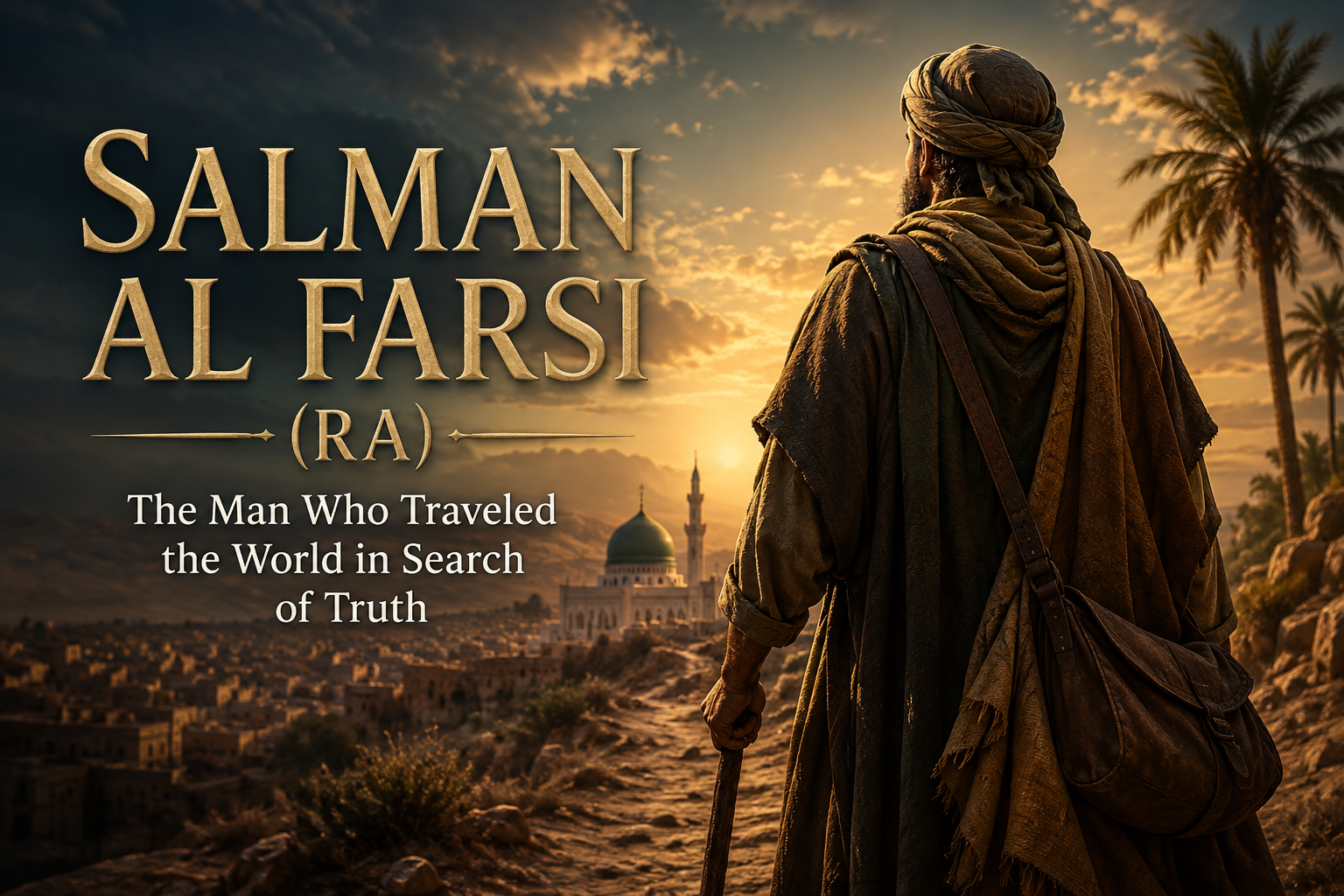

Some stories inspire us because they tell us about sacrifice.
And then some stories make us question our own search for truth.
The story of Salman Al Farsi (RA) belongs to that last category.
Born in Persia and raised in a privileged household, Salman had access to comfort, status, and security. Yet something inside him remained restless. He wanted to know the truth. Salman Al Farsi (RA)
That search would take him across lands, through different religious communities, into hardship, and eventually to Madinah, where he would meet the Prophet Muhammad ﷺ and embrace Islam.
His journey was not simply a journey from Persia to Arabia.
It was a journey from questions to conviction.
Read Also: Episode 03 Hazrat Khalid Ibn Al Walid (RA)
A Young Man, Salman Al Farsi (RA), Who Refused to Stop Searching
Salman Al Farsi (RA) came from Persia and was raised in a family associated with the Zoroastrian tradition.
According to traditional accounts of his life, his father was an influential man in his community and deeply protective of his son.
Salman was initially devoted to the religious tradition in which he had been raised. He was even entrusted with maintaining the sacred fire.
But his encounter with another religious community awakened something within him.
He began asking questions.
And once those questions started, he could not simply silence them.
Historical sources describe Salman as someone who continued searching through different religious teachers and communities. The journey eventually took him toward Syria and other parts of the region before he learned about the coming of a Prophet in Arabia.
This is one of the most remarkable lessons from his life.
A sincere search for truth requires courage.
Sometimes the hardest thing is not finding an answer.
It is admitting that the answer you inherited may not be the answer you are looking for.
The Journey That Cost Salman Al Farsi (RA) Everything
Salman’s search was not a comfortable intellectual exercise.
He paid a price for it.
He left behind the security of his family and homeland and travelled from one place to another in search of religious knowledge.
Eventually, according to the traditional account, he was betrayed during his journey and ended up being taken into slavery.
Imagine that.
A man who had once lived with privilege was now deprived of his freedom.
Yet even slavery could not destroy the purpose that had driven his journey.
He continued waiting for the truth he had spent years searching for.
The Search Finally Leads to Madinah
Eventually, Salman reached Madinah.
There he heard about Muhammad ﷺ.
The signs described to him by a previous religious teacher matched what he had been told to expect from the final Prophet.
Salman wanted certainty.
He approached the Prophet ﷺ with food and observed carefully how it was received. Traditional narrations describe how these encounters helped him recognize the signs he had been searching for.
When he finally became convinced, Salman accepted Islam.
The journey that had taken him across countries had finally reached its destination.
Not merely Madinah.
Faith.
The account of his search and acceptance of Islam is preserved in Islamic literature, including narrations attributed to Salman himself.
From Slave to Beloved Companion
Salman’s story did not end when he accepted Islam.
He still faced the reality of slavery.
The Prophet Muhammad ﷺ and the Muslims helped Salman secure his freedom. Traditional accounts describe an agreement involving the planting of date palms and a financial payment, after which Salman was freed.
Think about the transformation.
A man who had crossed lands searching for truth became a free man among the companions of the Prophet ﷺ.
His Persian background did not make him less important.
His former status as a slave did not make him less important.
Islam judged him by something far greater.
His faith.
His character.
His sincerity.
The Brilliant Idea That Changed the Battle of Khandaq
Salman Al Farsi (RA) would later become famous for another extraordinary contribution.
When Madinah faced a massive coalition during the Battle of Khandaq, Salman suggested an unusual defensive strategy.
Dig a trench around vulnerable parts of Madinah.
The idea was familiar in Persian military practice but unfamiliar to the Arabs at that time.
The Muslims followed the strategy and dug the trench.
The defensive barrier made it extremely difficult for the attacking forces to launch a conventional assault on Madinah.
Salman’s suggestion became one of the defining strategic moments of the Battle of the Trench.
Sources describing his biography consistently connect him with this famous recommendation and identify Khandaq as his first major battle with the Prophet ﷺ.
This moment teaches another powerful lesson.
Wisdom does not belong to one culture.
Salman brought knowledge from Persia and used it for the protection of the Muslim community.
His background was not something Islam asked him to erase.
It became part of the contribution he brought to the Ummah.
Salman Al Farsi (RA) and the Power of Knowledge
Salman’s life challenges a common misunderstanding about religious devotion.
Faith does not mean abandoning intelligence.
Salman was known for his wisdom and knowledge. His life combined spiritual conviction with practical thinking.
He searched deeply.
He listened.
He observed.
He learned.
And when the right moment came, he used what he knew to serve others.
That combination made him remarkable.
A believer can be deeply spiritual and highly intelligent.
A person can love tradition while still asking serious questions.
A Muslim can learn from different cultures while remaining firmly rooted in faith.
Salman’s life demonstrates all three.
A Man Who Valued Truth More Than Comfort
Perhaps the most powerful part of Salman’s story is not the trench.
It is everything that happened before the trench.
Before he became a famous Companion, he was simply a man looking for truth.
He left comfort.
He endured separation.
He travelled.
He learned.
He suffered.
He was enslaved.
And he continued.
That persistence is what makes his story so relevant today.
We live in an age where information is everywhere, yet genuine searching can be rare.
We can access thousands of opinions within seconds.
But wisdom requires something deeper.
Patience.
Humility.
Sincerity.
And the courage to follow the truth once we recognize it.
What Salman Al Farsi (RA) Teaches Us Today
1. Never Stop Searching for Truth
Salman’s life began with questions.
He did not allow uncertainty to become an excuse for giving up.
A sincere question can be the beginning of a life changing journey.
2. Do Not Let Your Background Limit You
Salman was Persian.
He was not an Arab.
He was also once enslaved.
Yet he became one of the most respected Companions of the Prophet ﷺ.
Your birthplace does not determine your worth.
Your character and faith matter far more.
3. Knowledge Should Become Service
Salman’s knowledge of Persian defensive strategy became useful during Khandaq.
Knowledge becomes truly valuable when it helps other people.
4. Hardship Does Not Mean You Are Lost
There were many moments when Salman’s journey must have appeared hopeless.
But every hardship became part of a larger journey toward his destination.
Sometimes the road to something meaningful is much longer than we expect.
5. Wisdom Can Come From Anywhere
Salman’s Persian background gave him knowledge that proved valuable to the Muslim community.
This teaches us to recognize wisdom wherever it exists.
Learn.
Evaluate.
Take what is beneficial.
Use it for good.
The Legacy of Salman Al Farsi (RA)
Salman Al Farsi (RA) remains one of the most inspiring figures in Islamic history because his life crossed boundaries that people often consider impossible to cross.
Persia to Arabia.
Privilege to slavery.
Searching to certainty.
Stranger to Companion.
Knowledge to service.
His story reminds us that Allah can guide a person through a journey that seems impossible to understand while it is happening.
Salman searched for truth for years.
When he found it, he did not hold back.
He gave his life to it.
And that may be the greatest lesson of all.
The real journey is not always the distance between two places.
Sometimes it is the distance between who we are today and the person Allah wants us to become.
Islamic Heroes Episode 04: The Final Lesson
Salman Al Farsi (RA) did not inherit his destination.
He searched for it.
He did not choose comfort over truth.
He chose truth over comfort.
He did not allow his nationality, social position, or difficult circumstances to define his value.
He became known for his faith, wisdom, and service.
For anyone struggling with questions about life, purpose, and faith, his story carries a timeless message:
Keep searching sincerely.
Because sometimes the longest journey of your life can lead you to the most beautiful destination.
May Allah be pleased with Salman Al Farsi (RA) and allow us to learn from his sincerity, patience, courage and wisdom.
Ameen.
Further Reading
For readers who want to explore the historical and hadith sources related to Salman Al Farsi (RA), useful references include Sunnah.com’s Salman Al Farsi collection and the TDV Islamic Encyclopedia entry on Salman Al Farsi.
For further stores and insights, keep visiting blogy365.com



Leave a Comment